
INC Presents Sustainability Certification to US Industry Professionals
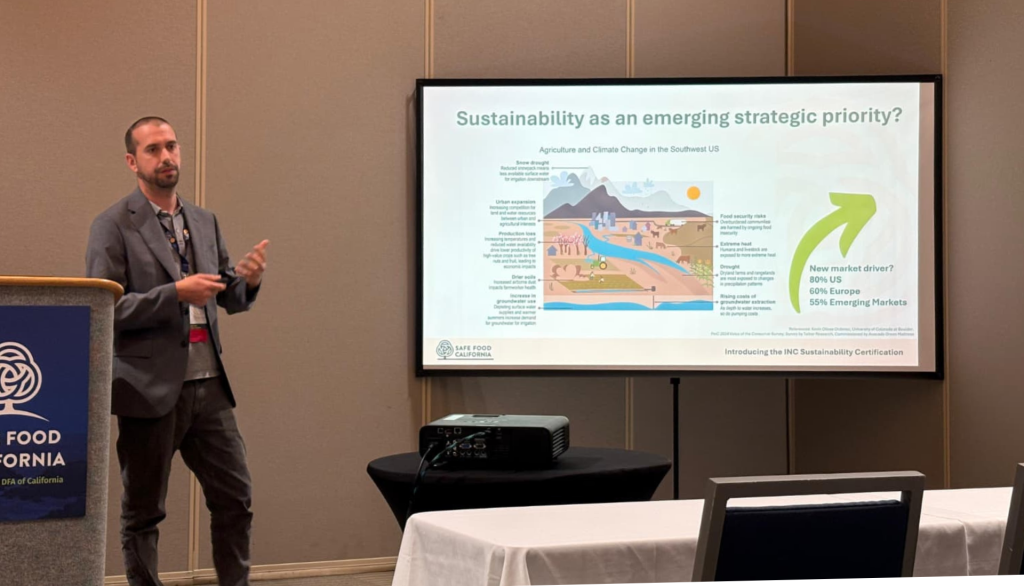
Following the formalization of its partnership with DFA of California as an official auditing body, the INC Sustainability Certification continues to gain strong momentum with first audits now underway! Most recently, the program was presented by INC Sustainability Manager, Ramon Botet, at Safe Food California—DFA’s flagship annual conference held in Monterey from April 7–9. The […]
Submit Your Entry for the INC Sustainability Award 2026!
Applications are now open! Download the Official Application Form – please read the guidelines below before filling it out. Showcase your company’s commitment to sustainability and gain global recognition at the 43rd World Nut & Dried Fruit Congress in Macao. The INC Sustainability Award honors outstanding initiatives in the nut and dried fruit industry across two categories: Back to the Planet: Honoring initiatives focused on […]
EU: Parliament Approves Simplified Sustainability Reporting and Due Diligence Requirements

On December 9, 2025, the European Parliament and Council reached a provisional agreement to simplify the Corporate Sustainability Reporting Directive (CSRD) and the Corporate Sustainability Due Diligence Directive (CSDDD). On December 16, the European Parliament formally adopted the deal in a plenary vote. Under the text approved by Parliament, social and environmental reporting is only required for EU companies […]
EU: Revised Trade Rules to Incentivize Sustainability in Developing Countries
The EU’s Generalized Scheme of Preferences (GSP) removes import duties from products coming into the EU market from vulnerable developing countries. On December 1, 2025, the European Commission, the European Council and the European Parliament reached an agreement on a revision of the GSP. The revised GSP will: The provisional agreement will now be endorsed […]
COP30 Delivers Climate Action Agenda in Brazil

The 30th United Nations Climate Change Conference (COP30) took place on November 6-21, 2025 in Belém, Brazil, bringing together the governments of signatory states to the United Nations Framework Convention on Climate Change (UNFCCC), as well as experts and civil society, to accelerate global climate action. Notably, for the first time since the COP conference series began, […]
EU: Parliament Adopts Negotiating Position on Simplified Sustainability and Due Diligence Rules
During the plenary session of November 13, the European Parliament adopted its negotiating position on simplified sustainability reporting and due diligence duties for businesses. Under the Parliament’s position, sustainability reporting would be lighter and only necessary for larger companies (businesses employing on average over 1,750 employees and with a net annual turnover of over €450 […]
INC Sustainability Certification: What It Is and Why It Matters for Your Business

For the nut and dried fruit industry, sustainability isn’t a trend, it’s a strategic priority. That’s why the INC launched the INC Sustainability Institute: a global platform helping to raise sustainability standards within the industry, share expertise, and accelerate meaningful progress across the supply chain. At the heart of this initiative is the INC Sustainability Certification, […]
EU: 50% Pesticide Reduction Target Reached Ahead of Schedule
In 2020, the European Commission announced two non-legally binding pesticide reduction targets: a 50% reduction in the use and risk of chemical pesticides, and a 50% reduction in the use of more hazardous pesticides (the so-called “candidates for substitution”). According to the most recent annual progress report published by the Commission, the first of these targets has already […]
EU: Updated Proposal to Restrict PFAS
PFASs are a group of thousands of almost exclusively man-made substances that are used in numerous applications, including food packaging. Concerns about PFAS mainly come from their environmental persistence and potential health effects. The publication of the updated proposal comes after an assessment of more than 5,600 scientific and technical comments received from third parties […]
Increasing the Oxidation Stability and Shelf-Life Quality of Hazelnuts Using a New Peeling Technique
Hazelnuts without skin are preferred by consumers. Traditionally, the skin is peeled off by the roasting technique (RT). However, RT causes undesirable reactions such as lipid oxidation. Therefore, pressurized water technique (PWT) was developed as an alternative hazelnut peeling method. In this study, the effect of PWT on quality parameters including chemical composition, ultrastructure, peroxide […]
Effects of introduced macadamia on soil organic carbon and water stocks in subtropical agroforestry systems of southwestern China
Macadamia (Macadamia integrifolia)-based agroforestry systems,widely adopted in Yunnan Province, China since 1981, are critical for soil organic carbon (SOC) sequestration. However, their effects on SOC stocks and coupling mechanisms with soil water dynamics remains poorly understood. This study quantified changes in SOC and soil water stocks following the conversion from primary forest to macadamia monoculture and intercropping systems (dasheen, konjac, and maize) in Yongde […]
Production of Filamentous Fungal Biomass (Aspergillus awamori) in Pellet Form from Almond Hull Extract
Fungal cultivation using agricultural byproducts is a sustainable approach to produce valuable bioproducts for applications such as protein-rich foods. In this study, Aspergillus awamori (A. awamori) was cultivated in batch flasks to investigate the effects of different nitrogen sources and initial carbon to nitrogen (C/N) ratios of 15, 30, and 45 on fungal yield and characteristics using […]
Mitigating tropical cyclone susceptibility in pecan (Carya illinoinensis) orchards
The production of tree nuts such as almonds, walnuts, pistachios, and pecans is a globally important agricultural industry. Climate risk posed to tree nut orchards was recently brought to light by a series of severe tropical cyclone impacts to the primary pecan-producing areas of Georgia, USA which caused $1.2 billion USD in losses. Understanding how […]
Management strategies to optimize peanut yields in Argentina under restrictive environmental conditions
Peanut production in Argentina is predominantly rainfed, with considerable variability in rainfall patterns within and between seasons. This variability results in droughts of varying duration and severity, which can significantly reduce yields. Water availability is, therefore, a critical factor in determining the optimal sowing date. The objectives of this study were to (i) assess the effects of sowing […]
Efficient and sustainable recovery of bioactive compounds from cashew nut testa shell (Anacardium occidentale L.) using pressurized liquid extraction
Cashew nut processing generates large quantities of byproducts daily, such as cashew nut testa shell (CNTS), which is discarded, leading to environmental and economic issues. However, CNTS contains bioactive substances such as polyphenols and antioxidant components, with potential for applications in the food, pharmaceutical, and chemical industries. This study investigated the optimization of pressurized liquid […]
From Waste To Wealth: Pistachio Green Hulls as a Novel Source of Antioxidants and Dietary Supplements
Pistacia vera L., known for its rich phenolic content and antioxidant potential, often has its hulls discarded. This study aimed to explore the antioxidant potential of pistachio green hulls, using advanced analytical methods to assess their suitability for dietary supplements. Green hull samples were collected, dried, and extracted with water, methanol, and hexane to isolate […]
Transforming almond shell waste into high-value activators for low-carbon concrete: life cycle assessment and technoeconomic analysis
Low-carbon concrete, including through the use of alkali-activated binders (AABs), is being developed globally to meet construction industry decarbonization goals by reducing reliance on Portland cement (PC). However, the cost and environmental impacts of the alkaline resources conventionally used in AABs are among the factors that have hindered their application. Here, life-cycle assessment (scope A1-A3) and technoeconomic […]
Vegetation Monitoring of Palm Trees in an Oasis Environment (Boudenib, Morocco) Using Automatic Processing of Medium-Resolution Remotely Sensed Data
Oases are part of the natural wealth and heritage of Morocco and contribute to the social, economic, and touristic environment. Morocco has lost more than 2/3 of its oases during the past century due to water scarcity, succession of drought periods, climate change and over-exploitation of groundwater resources. Palm trees are strongly dependent on irrigation […]
Upcycling Brazil nut press cake as an ingredient of an innovative spread and evaluation of its nutritional, functional, and sensory properties
Brazil nut press cake (PC), a co-product of oil extraction, represents a promising alternative for developing sustainable and nutritious food products, meeting the growing demand for healthy and clean-label options. This study aimed to assess the effects of PC on spread composition, physical characteristics, sensory attributes, consumer acceptance, and storage stability assessed through oil separation. […]
Impact of cashew cultivation on food security, sovereignty, and income diversification in Jaman North District, Ghana
Smallholder farmers in the forest-savanna transition zone of mid-Ghana have historically relied on food crop cultivation for their livelihoods. However, cashew production is rapidly gaining prominence due to a combination of climatic and non-climatic factors. This shift raises concerns about competition for resources between cashew and food crops, as dedicating productive land and inputs to […]
Understanding the photosynthesis in relation to climate change in grapevines
Due to predicted global climate change, there have been significant alterations in agricultural production patterns, which had a negative impact on ecosystems as well as the commercial and export prospects for the production of grapevines. The natural biochemistry of grapevines, including their chlorophyll content, net photosynthetic rate, Fv/Fm ratio, photorespiration, reduced yield, and quality is […]
Optimization of irrigation on walnut through the IRRIFRAME water balance model
In recent years, reduced summer precipitation frequencies related to climate change have raised the probability of water scarcity, even in the Po Valley of Italy, thus requiring an optimization of the irrigation management for walnut cultivation which has become very present in the area. The aim of the present study was to evaluate, during four […]
Microbial dynamics and agroforestry impact on soil ecosystem multifunctionality following forest conversion to macadamia-based systems
Forest conversion to agroforestry systems has the potential to impact soil ecosystem functions in terrestrial ecosystems and optimize crop management, which may play a critical role in sustaining soil ecosystem multifunctionality (EMF, defined as simultaneously provision of multiple ecosystem functions) in a subtropical agroforestry system. However, the impact of sowing crops on soil EMF and […]
Carbon Sequestration Potential of Cashew (Anacardium occidentale L.) Plantations Across Climatic Gradients in Togo
The current study seeks to estimate the carbon sequestration capability of a cashew plantation in Togo as a function of climate gradient. The research was conducted in the Guinean and Sudanian climatic zones, on farmers’ cashew plantations. The study was run from March to October 2023. This study was carried out in ten (10) cashew […]
Halotolerant Pseudomonas-induced alleviation of salt stress and promotion of growth in peanut (Arachis hypogaea)
Salinity stress is a major abiotic factor limiting crop productivity, particularly in sensitive crops like peanuts (Arachis hypogaea). This study evaluated the potential of Pseudomonas geniculata ND09 in alleviating salt stress impacts on peanut growth under controlled and field conditions. In pot experiments, salt stress significantly reduced root and shoot lengths, biomass, and pod yield while increasing […]
Land Use/Change and Local Population Movements in Stone Pine Forests: A Case Study of Western Türkiye
One of the important distribution areas of stone pine (Pinus pinea L.), a native tree species of the Mediterranean Basin in Türkiye, is the Kozak Basin. Pine nut production plays an important role in the livelihood of the rural people of the Kozak Basin. However, in recent years, as a result of mining activities, climate change, […]
Evaluation of Physiological Changes in Important Dried Apricot Varieties Under Drought Stress
Nearly all of the apricot varieties grown in Malatya are dried apricots and the plantation areas in this region are expanding daily. Due to the impact of climate change, producers are growing apricots mostly under limited irrigation or even dry conditions. Therefore, it is essential to determine the drought resistance characteristics of the varieties commonly […]
Water use dynamics of almond and pistachio crops in the Mediterranean region amid climate change
Almond and pistachio are socio-economically significant tree crops grown in California’s San Joaquin Valley (SJV). Continuing commercial production with efficient irrigation planning under changing climate requires an extensive understanding of their biophysical interactions such as altered phenology, biomass accumulation, transpiration, and other processes. This study examines the phenology and water use (ETc) responses of almonds and […]
Native cover crops enhance biodiversity and ecosystem services in hazelnut orchards
Agroecological restoration aims to restore biodiversity and ecosystem function in agricultural landscapes while sustaining crop production. Adopting native plants as cover crops may restore ecological value to cropping systems such as nut orchards. We focused on Oregon hazelnut orchards and compared how four seed mixes (native annuals, native perennials, conventional cover crops and unseeded controls) […]
Intercropping alfalfa during almond orchard establishment reduces winter soil nitrogen and water losses, provides on-farm revenue
The ecosystem benefits linked to intercropping and diversified agroecosystems is an area with increasing research interest, particularly in sustainable food production and farm resilience to extreme climate variability. Interrow cropping of alfalfa (Medicago sativa L.) in almond [Prunus dulcis (Mill.) D. A. Webb] orchards during the 3–4 non-bearing, establishment years has potential to advance sustainable intensification in […]
EU: Recommendation on Voluntary Sustainability Reporting for SMEs
In July, the European Commission adopted a recommendation on voluntary sustainability reporting for small and medium-sized enterprises (SMEs). The recommendation presents a voluntary standard that will make it easier for SMEs that are not covered by the Corporate Sustainability Reporting Directive (CSRD) to respond to specific requests for sustainability information from large financial institutions and companies. To […]
USA: Expedited Disaster Assistance for Farmers

The U.S. Department of Agriculture announced in July that agricultural producers who suffered eligible crop losses due to natural disasters in 2023 and 2024 could apply for US$16 billion in assistance through the Supplemental Disaster Relief Program (SDRP). To expedite the implementation of SDRP, the USDA’s Farm Service Agency (FSA) is delivering assistance in two stages. This […]
EU: “Quick Fix” Adopted for Companies Already Conducting Corporate Sustainability Reporting
On July 11, 2025, the European Commission adopted targeted “quick fix” amendments to the first set of European Sustainability Reporting Standards (ESRS). These amendments are intended to reduce burden and increase certainty for companies that had to start reporting for financial year 2024 (commonly referred to as “wave one” companies). According to the current ESRS, companies reporting on […]
UK: Green Taxonomy Plans Scrapped After Public Consultation

On July 15, 2025, the UK government announced that it would not move forward with creating a UK Green Taxonomy. In light of the results of a public consultation, the government concluded that a UK Green Taxonomy would not be the most effective tool to deliver the green transition and should not be part of the country’s sustainable […]
GRI: Launch of New Climate Change and Energy Standards

In June 2025, the Global Reporting Initiative (GRI) announced the launch of new climate change and energy standards to empower organizations to take accountability for their impacts and accelerate climate action. Both standards are based on scientific and authoritative global instruments on climate change and fully aligned with the GHG Protocol. This article originally appeared on inc.nutfruit.org.
EU: Taxonomy Simplification Measures
On July 4, 2025, the European Commission adopted a set of measures to simplify the application of the EU Taxonomy, the EU’s classification system of sustainable economic activities and investments. The changes are intended to reduce the administrative burden for EU companies, thus enhancing EU competitiveness while preserving core climate and environmental goals. The main […]
EU: Commission Guidance on Deforestation Regulation
In June 2025, the Global Reporting Initiative (GRI) announced the launch of new climate change and energy The European Commission has published a notice providing clarifications and guidance on certain aspects of Regulation (EU) 2023/1115 on Deforestation-Free Products (EUDR). In particular, the notice clarifies the circumstances under which packing does not fall under the scope of the EUDR: In addition, the […]
EU: Council Approves Negotiating Mandate on Simplifying Sustainability Reporting and Due Diligence Requirements
On June 25, 2025, EU member states’ representatives agreed on the Council’s negotiating mandate on simplifying sustainability reporting and due diligence requirements to boost EU competitiveness. The proposal, which forms part of the “Omnibus I” package adopted by the Commission in February, aims to simplify the directives on corporate sustainability reporting and due diligence by reducing the […]
EU: Commission Withdraws Green Claims Proposal
On June 20, 2025, the European Commission announced its intention to withdraw its Green Claims proposal, as reported by Euronews. This surprise decision marks the latest withdrawal of a major Green Deal initiative following the publication of the Commission’s “Omnibus” package aimed at simplifying EU legislation. Initially proposed in March 2023, the Green Claims Directive was […]
Türkiye-Georgia: Brown Marmorated Stink Bug Update
The hazelnuts round table at the INC Congress in Mallorca featured interesting updates on efforts in Türkiye and Georgia to mitigate the threat of the brown marmorated stink bug (BMSB). Native to Asia, the BMSB was first detected in Türkiye around 2017–2018 and was initially confined to the Rize and Artvin regions. Since then, it […]
USA: Researchers Generate Comprehensive Pistachio Genome Sequence
Researchers from the University of California, Davis have generated the most comprehensive genome sequence of the pistachio ever published. The findings from their study could allow plant breeders to create better and possibly more nutritious pistachio varieties. Moreover, the researchers’ insights on how pistachio nuts develop may enable growers to manage their crops more sustainably. More information
EU: Parliament Votes to Delay Application of Due Diligence and Sustainability Reporting Rules.

On April 3, 2025, the European Parliament voted to postpone the application dates for new EU laws on due diligence and sustainability reporting requirements. The Parliament’s vote comes after the Council approved its negotiating mandate in late March. Member states will have an extra year —until July 26, 2027— to transpose the new due diligence rules into national legislation. The one-year […]
Spain: New Food Waste Prevention Law

Spain has passed a new law on food waste prevention. Effective as of April 1, 2025, the law aims to reduce food waste through mandatory measures across the food supply chain. Key provisions: Specific sector requirements: Exemptions include businesses with fewer than 10 employees, small farms, and establishments under 1,300m². Companies have until April 2026 to […]
UK: Government Launches National Action Plan on Pesticides
On March 21, 2025, the United Kingdom announced a new National Action Plan on Pesticides. The plan envisages a future of more sustainable pesticide use, while boosting food production in the long term. The plan sets out how all four UK governments will support farmers, growers, and other land managers to voluntarily increase their use […]
UNECE Code of Good Practice: Reducing food loss and ensuring optimum handling of nuts and dried fruits along the value chain

The INC is leading a UNECE working group in charge of developing a Code of Good Practice on reducing food loss and ensuring optimum handling of nuts and dried fruits throughout the value chain. This Code of Good Practice will support Sustainable Development Goal (SDG) 12 “Ensure Sustainable Consumption and Production Patterns”, specifically target 12.3 […]